

Saving a Piece of Home: A 1950s Intercom Reimagined


In late 2022, I was contacted about a restoration project unlike anything I had taken on before.
The customer had grown up in a house equipped with a large, vacuum-tube intercom and radio system built directly into the wall. Years later, while visiting the vacant property with his children, he discovered that the old intercom was still there.
Knowing the house would eventually be demolished, he removed the unit and saved it.
It was no longer simply an obsolete piece of electronics. It was a surviving piece of his childhood home.
For years, he kept it without knowing exactly what to do with it. Eventually, he contacted me to see whether it could be given a second life—not necessarily as the intercom it had once been, but as something that could once again be seen, heard and enjoyed.
His email stated the following: "Full disclosure: I went to visit my childhood home with my kids when they were pretty young (about 10 years ago) and it was vacant and we were walking around the property. Then I happened to notice the back door was open so we went in so I could show them the old house. That's when I noticed this on the wall and I just yanked it out. I may have damaged it as I didn't extract it gently. That said, the house was later demolished so I think I ended up saving a cool piece of vintage gear. "
Choosing a New Direction
The original electronics were far beyond practical restoration. Much of the wiring was missing or severely deteriorated, several components had been damaged, and the system had originally relied on additional equipment installed throughout the house.
Restoring it to its original function would not have been realistic.
Instead, we decided to preserve the appearance and physical character of the intercom while converting it into a self-contained Bluetooth audio system.
The goal was not to disguise it as something new. The goal was to make it appear alive again.


Preserving the Original Character
The intercom’s metal faceplate was heavily tarnished and required aggressive cleaning, but I wanted to retain as much of its original finish and coloration as possible. The objective was preservation, not erasure. Some signs of age belonged there.
The original knobs, dials and switches were cleaned and retained. Although most of the switches are no longer electrically functional, they still move and operate mechanically as they did decades ago.
Several vacuum tubes were still present in their original sockets. Missing tubes were replaced with nonfunctional examples so that the chassis would once again appear complete.
Warm orange LEDs were installed beneath the tubes to reproduce the subtle glow they would have produced while operating. Additional LEDs replaced the original incandescent panel lamps.
The effect is especially convincing in a dimly lit room: the tubes appear to be gently warming to life, even though the original high-voltage circuitry is no longer energized.


Building the Cabinet
Because the intercom had originally been mounted inside a wall, it had no finished enclosure of its own. I designed and built a freestanding cabinet around it using birch and walnut.
The walnut frame provided a warm, period-appropriate contrast to the lighter birch front panel. The wood was finished with Varathane Jacobean oil-based stain, giving the cabinet an aged appearance that complemented the intercom rather than making it look overly new.
A clear 4 mm acrylic rear panel allowed the original vacuum tubes, chassis and internal structure to remain visible.

Modern Audio, Hidden Inside
A compact Bluetooth amplifier module was installed inside the cabinet and paired with two small flush-mounted speakers.
Despite their size, the speakers provide surprisingly full and clear sound. Their impedance was carefully matched to the amplifier module, and the system is powered by a regulated, non-switching 5-volt DC power supply that I built specifically for the project.
Avoiding a typical switching power supply helped keep electrical noise out of the audio system.
The original phono control could not be salvaged, so its location was repurposed for a discreet toggle switch that powers the Bluetooth amplifier. This allowed the new control to remain visually integrated with the original panel rather than adding an obviously modern switch elsewhere.
Once powered on, the system can receive audio from a phone, tablet, computer or Bluetooth-equipped turntable.

Back Home Again
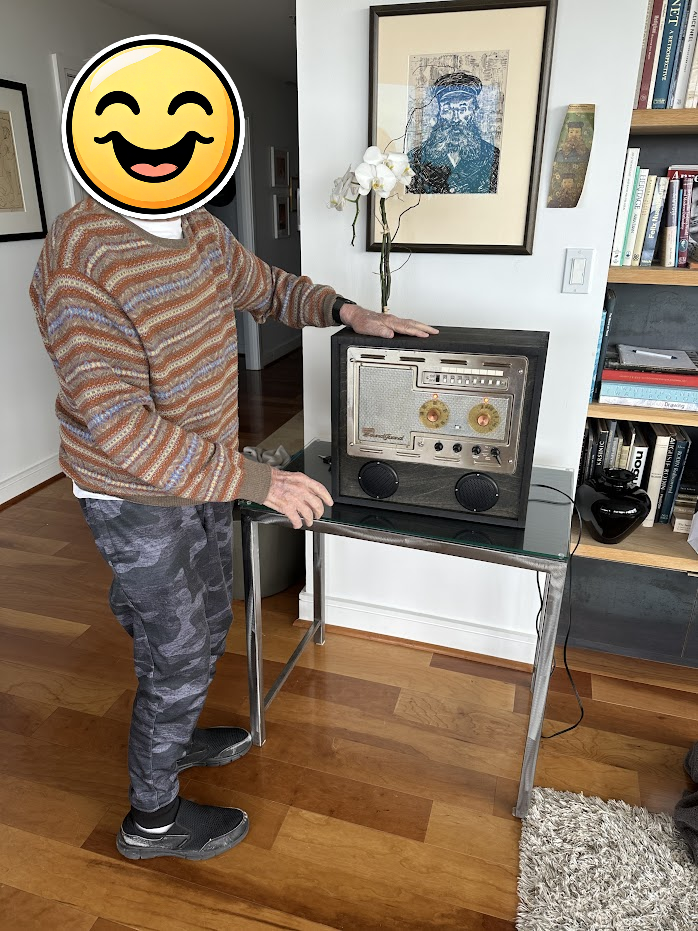
The completed unit now sits in the customer’s home, where his Bluetooth turntable connects directly to it.
What began as a damaged wall intercom from a condemned house became a functional piece of furniture, a Bluetooth music system and, most importantly, a tangible connection to the home where he grew up.
One of the most meaningful moments came when the customer shared a photograph of his 94-year-old father standing beside the completed piece.
Projects like this are a reminder that restoration is not always about returning an object to its exact original specifications. Sometimes the original function is gone, the supporting system no longer exists, or a conventional restoration is simply no longer possible.
In those cases, the more important task may be preserving the object’s presence, character and story.
This intercom will never call from one room of the old house to another again.
But it plays music. Its dial glows. Its tubes appear warm once more.
And a small piece of that house survived.


